Understanding Concrete and Its Environmental Exposure Classes
Concrete is one of the fundamental materials in construction, and its properties are essential for the safety and durability of various structures. To ensure proper concrete selection for a specific project, it is important to understand concrete environmental exposure classes and their significance. These classes are defined according to LVS EN 206:2014 and LVS 156-1:2017 standards, which determine concrete resistance to various external factors.
Why are concrete environmental exposure classes important?
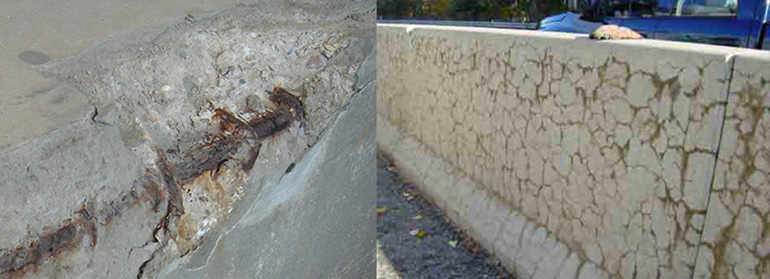
(Image source: https://en.wikipedia.org/wiki/Concrete_degradation)
Depending on the project location and planned structural operating conditions, concrete must be able to withstand various external influences, such as moisture, temperature fluctuations, chemical exposure, and other factors. Concrete environmental exposure classes provide information about concrete resistance to these influences, helping to select the most suitable material for specific applications.
Selecting an inappropriate concrete class for a specific building structure can lead to premature deterioration, structural damage, or even loss of structural integrity, creating potential safety risks and increased long-term financial costs for repair and renovation.
Main concrete environmental exposure classes
XO
Class where no risk of corrosion or attack exists. Suitable for concrete without reinforcement or embedded metal in very dry environments.Carbonation-induced corrosion
- XC1 - Dry or permanently wet environment.
- XC2 - Wet, rarely dry environment.
- XC3 - Moderately humid environment.
- XC4 - Cyclically wet and dry environment.
Chloride-induced corrosion, other than from sea water
- XD1 - Moderately humid environment.
- XD2 - Wet, rarely dry environment.
- XD3 - Cyclically dry and wet environment.
Chloride-induced corrosion from sea water
- XS1 - Concrete exposed to airborne salt but not in direct contact with sea water.
- XS2 - Permanently submerged structure.
- XS3 - Tidal, splash and spray zones.
Freeze/thaw attack with or without de-icing agents
- XF1 - Moderate water saturation, without de-icing agents.
- XF2 - Moderate water saturation, with de-icing agents.
- XF3 - High water saturation, without de-icing agents.
- XF4 - High water saturation, with de-icing agents or sea water.
Chemical attack
- XA1 - Slightly aggressive chemical environment.
- XA2 - Moderately aggressive chemical environment.
- XA3 - Highly aggressive chemical environment.
When selecting concrete for a specific building structure, it is essential to consider environmental exposure classes. They help ensure that the selected material can withstand the intended operating conditions, guaranteeing structural safety, durability, and functionality in the long term.
Concrete strength classes. What does C30/37 mean?
Concrete strength class is an essential indicator that shows the material's ability to withstand specific pressure before failure. Concrete strength classes are designated with the letter C (Concrete), followed by two numbers. The first value indicates the cubic specimen compressive strength in megapascals (MPa) 28 days after casting, while the second indicates the cylindrical specimen compressive strength. For example, concrete class C30/37 means that the cubic specimen compressive strength after 28 days is 30 MPa, while the cylindrical specimen is 37 MPa.
Concrete strength classes include a wide range, from C12/15 up to C100/115, where each number indicates the material's ability to withstand compression. The higher the class, the greater the concrete's compressive strength, allowing structures to withstand greater loads.
These classes are extremely important during the design stage, as they help engineers and architects select the appropriate concrete type to ensure structural safety, durability, and sustainability. Depending on structural requirements, exposure conditions, and expected loads, an appropriate concrete strength class will be selected to guarantee compliance with all requirements and standards.
Concrete consistency classes
Fresh concrete consistency and workability class is a property that characterizes concrete's ability to flow and ensures its workability in forms and around reinforcement. Consistency classes, defined according to EN 12350-2 standard, are divided into five main levels: S1 to S5. Consistency class S1 indicates concrete mixtures with low workability. Class S5 indicates very high workability, ensuring easy concrete placement in very complex structures.